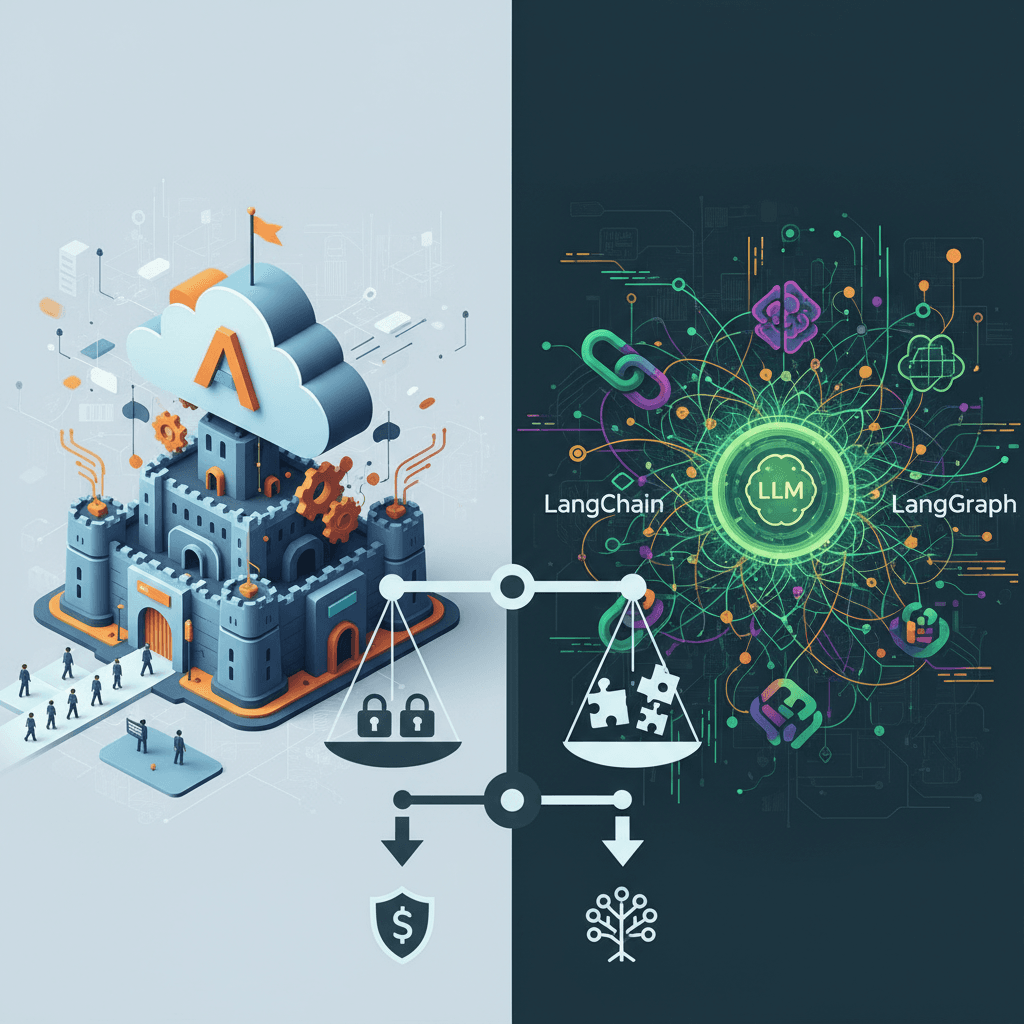
The rise of autonomous AI agents has created two distinct paths for enterprises: managed platforms like Salesforce Agentforce, and custom-built agent systems using LangChain, LangGraph, and LLMs.
At first glance, both seem to solve the same problem: "Build agents that can reason, decide, and act." But underneath, they represent fundamentally different philosophies. This blog breaks that down — not at a surface level, but at the level that matters for architects, platform leaders, and decision-makers.
The Universal Anatomy of an AI Agent
Before comparing platforms, let's anchor on a shared model. Every production-grade agent system consists of:
- Intent Understanding — What is the user/system asking?
- Prompt Engineering — How do we instruct the model?
- Context Engineering — What data is provided?
- Inference / Reasoning — How does it decide next steps?
- Tools / Skills — What actions can it take?
- Orchestration — How are multi-step workflows managed?
- Governance / Guardrails — What keeps it safe and compliant?
The real question is: Who owns the complexity of these layers — you or the platform?
Agentforce: The Managed Agent Platform
Agentforce is Salesforce's answer to enterprise AI agents — not just LLM access, but a fully integrated execution layer across CRM workflows. Its core philosophy: abstract complexity, embed intelligence into business workflows, and enforce governance by design.
- Context Engineering (Its Biggest Strength): Agentforce is context-first, not prompt-first. Native access to CRM objects, Data Cloud unified profiles, and real-time signals — no custom vector pipelines needed. Most AI failures are context failures, not model failures.
- Tools as First-Class Citizens: Agents act through Apex, Flows, and APIs — transaction-safe, governed, and role-aware. Actions are enterprise-compliant by default.
- Built-in Orchestration: Multi-step reasoning handled internally. Flow acts as the orchestration backbone. No need to build state machines manually.
- Governance & Guardrails: RBAC, audit logs, prompt constraints, and action restrictions built in. In regulated industries, this is non-negotiable.
LangChain / LangGraph: The Custom Agent Stack
If Agentforce is a managed platform, LangChain and LangGraph are developer toolkits. Core philosophy: maximum flexibility, full control, minimal abstraction.
- Flexibility: You control prompt structure, tool design, orchestration logic, and model selection. You can build anything — but you must build everything.
- LangGraph = Real Agent Power: Stateful workflows, DAG-based execution, and multi-step reasoning. The closest open-source equivalent to Agentforce orchestration.
- Cross-System Intelligence: Excels when integrating multiple systems, operating outside CRM, or needing fully custom AI behaviors.
Side-by-Side: Where They Truly Differ
- Intent — Agentforce: CRM-aware, built-in | LangChain: Prompt/classifier-based
- Prompting — Agentforce: Abstracted | LangChain: Manual
- Context — Agentforce: Native (Data Cloud + CRM) | LangChain: Custom pipelines
- Tools — Agentforce: Apex/Flow (governed) | LangChain: Functions/APIs (custom)
- Orchestration — Agentforce: Built-in | LangChain: LangGraph (manual)
- Governance — Agentforce: Enterprise-grade | LangChain: Must build
- Time to value — Agentforce: Fast | LangChain: Slow
- Flexibility — Agentforce: Moderate | LangChain: Very high
The core insight most people miss: Agentforce is a context + governance platform. LangChain is a reasoning + orchestration toolkit. They are not competitors in the traditional sense — they solve different layers of the problem.
LLM vs Agentforce: A Critical Distinction
- Generate text — LLM: Yes | Agentforce: Yes
- Understand business context — LLM: No | Agentforce: Yes
- Execute actions — LLM: No | Agentforce: Yes
- Govern behavior — LLM: No | Agentforce: Yes
Bottom line: LLMs generate answers. Agentforce delivers outcomes.
Real-World Example: Billing Issue Resolution
- With Agentforce: Detect intent → pull usage data (Data Cloud) → analyze variance → explain to customer → create case if needed. Minimal engineering. High reliability.
- With LangChain: Build an intent classifier, create data pipelines, manage a vector DB, define tool interfaces, orchestrate via LangGraph, add logging + guardrails. Maximum flexibility. Maximum effort.
Which Approach Is Best?
- Choose Agentforce when you are deeply invested in Salesforce, your workflows are CRM-driven, governance and compliance matter, and you want faster time-to-value. Ideal for customer support, sales automation, and billing/CPQ workflows.
- Choose LangChain / LangGraph when you need cross-platform AI orchestration, you're building a custom AI product, you require full control over behavior, and you have strong AI engineering capability. Ideal for AI-native platforms, complex multi-system automation, and experimental use cases.
- The best strategy is hybrid: LangGraph orchestrates complex cross-system workflows while Agentforce executes CRM-native actions. The most mature enterprises are combining both.
The Hidden Cost Tradeoff
- Engineering effort — Agentforce: Low | LangChain: High
- Control — Agentforce: Medium | LangChain: High
- Risk — Agentforce: Low | LangChain: High
- Innovation speed — Agentforce: Medium | LangChain: High
- Maintenance — Agentforce: Low | LangChain: High
Closing Thought
The real challenge isn't building agents — it's managing context, controlling actions, ensuring predictability, and enforcing governance. Agentforce solves these through abstraction. LangGraph exposes them for customization.
If you're building enterprise AI inside Salesforce, Agentforce is not just the better option — it's the practical one. If you're building AI as a product, LangChain and LangGraph give you the freedom you need. The future is composable AI architectures where managed platforms and custom frameworks coexist — each doing what they do best.
Suggested next step: Map one real use case (e.g., usage-based billing). Design it once using Agentforce, and once using LangGraph. That exercise alone will sharpen your architectural instincts more than any blog.
Mani G | Keneland — Salesforce + AI, shipped fast.