
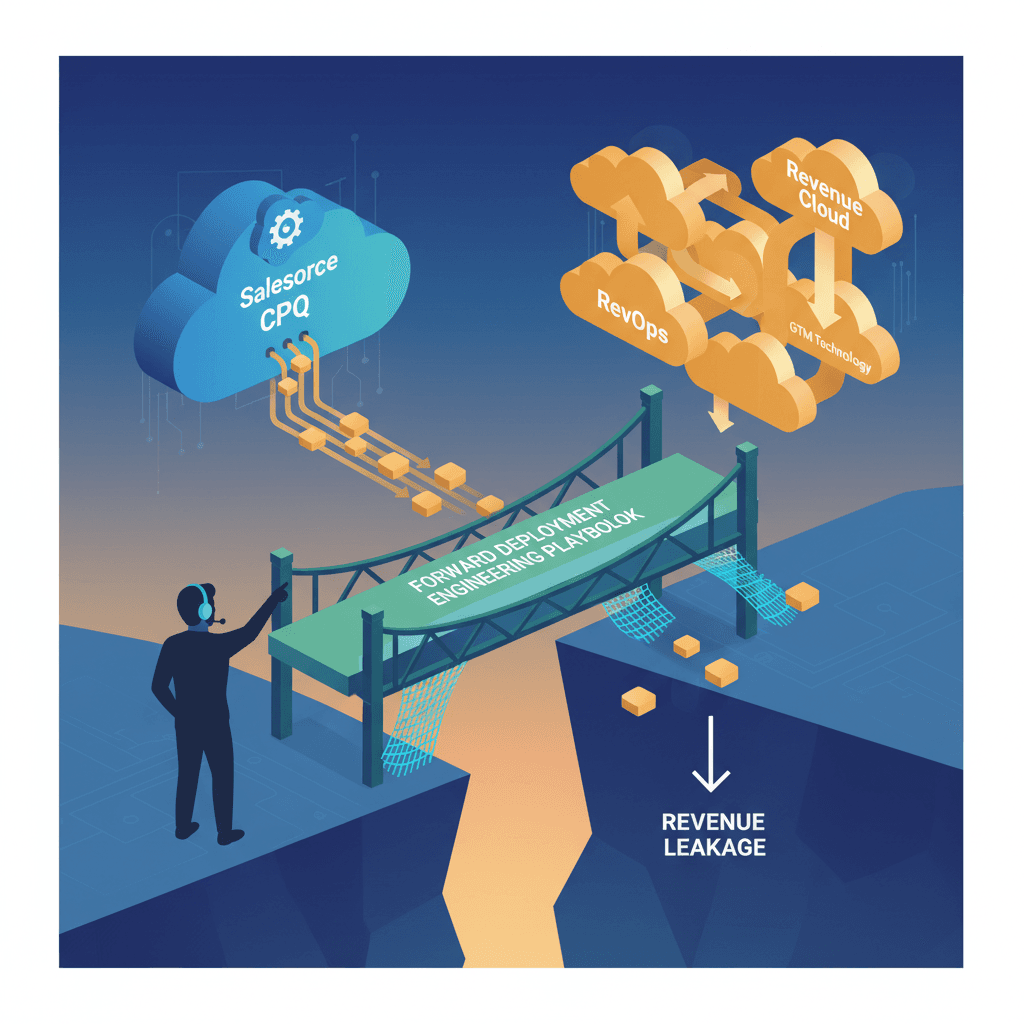
The $2M Question Every CPQ Customer Is Asking in 2026
If you are running Salesforce CPQ (Steelbrick / SBQQ), you already know the headline: Salesforce is steering customers toward Revenue Cloud, the new agentic, API-first revenue lifecycle platform that plugs into Agentforce, Data Cloud, and the broader Einstein 1 stack.
The strategic upside is real — composable pricing, headless quoting, native subscription management, and AI-driven deal desk workflows. But every RevOps leader I talk to is asking the same three questions:
- How do we migrate without freezing the sales pipeline for a weekend?
- How do we prove — to the CFO and the auditors — that not a single dollar of pipeline value was lost in the cutover?
- How do we keep the existing CPQ org running deals while Revenue Cloud is being built in parallel?
This post is the short version of the playbook I built for exactly that problem. At the bottom, you can download the full Migration Playbook (Word) and the 11-sheet Toolkit (Excel) that my team uses on live engagements.
Why Most CPQ → Revenue Cloud Migrations Bleed Revenue
In the projects I have audited, the failure pattern is almost always the same:
- Big-bang cutover over a weekend, with sales locked out of quoting for 48–72 hours.
- Pricing rules rebuilt from memory instead of decoded from the existing SBQQ price rules, discount schedules, and product rules.
- No reconciliation harness — teams compare totals, but never compare pipeline value by stage, by business unit, by quote line, and by ARR simultaneously.
- Hypercare treated as an afterthought — defects pile up in week 2 because nobody owns the daily inflow tracker.
The result is the thing every CRO fears: deals that worked on Friday do not work on Monday, and the pipeline number on the QBR slide does not match the number in the new system.
The Forward Deployment Engineering (FDE) Approach
Forward Deployment Engineering is the model Anthropic, OpenAI, and the top Salesforce ISVs use to ship complex platform work: a small embedded team of senior engineers sits inside the customer's RevOps and Sales Engineering org, owns the hardest 20% of the build personally, and transfers the rest as reusable patterns.
For a CPQ → Revenue Cloud migration, FDE looks like this:
- One senior FDE owns the pricing translation layer end-to-end. This is the single highest-risk surface area and it should never be split across three contractors.
- Daily working sessions with the customer's RevOps lead, not weekly steering committees.
- Every artifact is a template, not a one-off. Test plans, RAID logs, dependency matrices, cutover runbooks — all reusable across engagements.
- The FDE writes the reconciliation queries themselves rather than handing them to QA, because the FDE is the only person who knows exactly which fields were transformed.
This is the model the playbook is built around.
The Parallel-Run + Phased Cutover Strategy
The single most important architectural decision in this migration is: do not turn off CPQ until Revenue Cloud has been carrying production traffic for at least 2 weeks.
The playbook uses a 5-wave phased cutover pattern:
WaveWhat Goes LiveRisk ProfileWave 0Read-only sync, dual-write disabledZero — observability onlyWave 1New net-new quotes in Revenue Cloud (1 BU)Low — small blast radiusWave 2Renewals + amendments in Revenue Cloud (same BU)MediumWave 3All BUs net-new + renewalsHighWave 4Legacy CPQ frozen, full cutoverCutover gate
Between Wave 0 and Wave 4, Platform Events + Change Data Capture keep CPQ and Revenue Cloud in sync in both directions. Sales reps never lose access to a quote, and Finance always has a single source of truth for pipeline value.
The real cutover window — the part where you actually flip the switch — collapses from a 48-hour outage to a sub-4-hour data migration window on a Saturday morning, because 95% of the data is already replicated and reconciled.
Pipeline Value Reconciliation: The Non-Negotiable
Here is the reconciliation framework I require on every engagement. Tolerance is 0.0% on every dimension — not "close enough."
- Total open pipeline value (CPQ vs RC)
- Pipeline value by stage
- Pipeline value by business unit
- Pipeline value by close quarter
- Quote count
- Quote line count
- ARR (annualized recurring revenue)
- TCV (total contract value)
If any of these eight dimensions disagree by even one cent, the cutover is NO-GO. The toolkit ships with a reconciliation worksheet that calculates variance and flips the gate to PASS/FAIL automatically.
This is the artifact that keeps the CFO comfortable and the auditors happy.
What Is in the Free Toolkit
The downloadable bundle includes everything an FDE team needs to walk into a CPQ → Revenue Cloud engagement on day one and start delivering:
Migration Playbook (Word, ~50 pages)
- Executive overview and FDE operating model
- 6-phase project plan from discovery through hypercare
- Dependency management framework
- Full parallel-run + phased cutover strategy
- Hour-by-hour cutover runbook (Friday 6 PM through Saturday 4 PM)
- Pipeline value validation framework
- Document templates inventory
- Operating principles for the embedded team
Migration Toolkit (Excel, 11 sheets)
- README and sheet inventory
- Phase Plan with auto-calculated Gantt dates
- RAID Log with risk scoring and conditional formatting
- Dependency Matrix with criticality scoring
- CPQ → Revenue Cloud Data Mapping template
- Pricing Rule Translation worksheet (SBQQ Price Rules → RC Pricing Procedures)
- Test Plan with COUNTIF coverage summary
- Defect Log with P1–P4 severity and automatic cutover gate
- Cutover Checklist (14 hour-by-hour steps)
- Pipeline Reconciliation worksheet with PASS/FAIL gate
- Hypercare Tracker for daily defect inflow
Both files are fully editable and reusable across engagements. No watermarks, no signup wall on the content itself — just drop your email below.
Who This Is For
- RevOps leaders scoping a 2026 Revenue Cloud transition
- Salesforce Practice Directors at SI partners who want a reusable accelerator
- CPQ admins who have inherited a migration project and need a starting point
- Forward Deployment Engineers who want a battle-tested template library
- CFOs and Finance Systems leaders who need to defend pipeline integrity to the audit committee
If you are evaluating Revenue Cloud, Agentforce for Sales, or thinking about how agentic workflows will reshape your quote-to-cash stack in the next 18 months, this is the playbook I would hand you on day one of an engagement.
Download the Playbook + Toolkit
→ Get the full Migration Playbook (Word) and 11-sheet Toolkit (Excel) — free.
Drop your work email and I will send both files plus a 30-minute optional walkthrough invite. No sales pitch, no drip sequence — one email, two attachments, done.
Download the CPQ → Revenue Cloud Migration Bundle
About the Author
Mani G is an Applied AI Strategist focused on GTM technology , He has spent the last decade designing agentic AI systems, multi-tenant SaaS platforms, and Salesforce-native revenue automation tooling for enterprise customers. His recent work includes NOVA, a LangGraph-based agentic GTM orchestrator with native Salesforce MCP integration, and ASDA a multi-agent engineering team orchestration platform.
If you want to talk about your CPQ → Revenue Cloud migration, Agentforce rollout, or agentic AI strategy for BFSI, reach out at Mani@keneland.com.
Tags: Salesforce, Revenue Cloud, CPQ, Agentforce, Forward Deployment Engineering, RevOps, BFSI, Fintech, Migration, Quote-to-Cash